

Does PMOS Affect the Brain? Understanding PMOS and Cognition
Exploring the link between PMOS and cognitive health

Happy Tuesday! This piece is Part Eight of my PMOS Diaries series, where I share my personal experience with PMOS alongside research-informed insights. If you’re new here, you can read it as a standalone essay or explore the rest of the series for more context.
Note: These studies were conducted before the PMOS name change. I use PCOS throughout this piece when referring to the studies for consistency with literature.
Although PCOS may be linked to other brain-related symptoms such as anxiety, depression, and brain fog, this piece focuses specifically on cognition and how PCOS may affect memory, attention, and other thinking skills.
Polyendocrine Metabolic Ovarian Syndrome (PMOS) is a complex hormonal and endocrine disorder affecting more than 170 million women worldwide. Despite the discourse usually being around gynecological, metabolic, and endocrine perspectives, evidence suggests it may also be associated with differences in cognition and brain activity. Along with more visible symptoms such as irregular menstrual periods, excess hair growth, acne, and infertility, women with PCOS may experience less visible symptoms such as mood disturbances and cognitive difficulties.
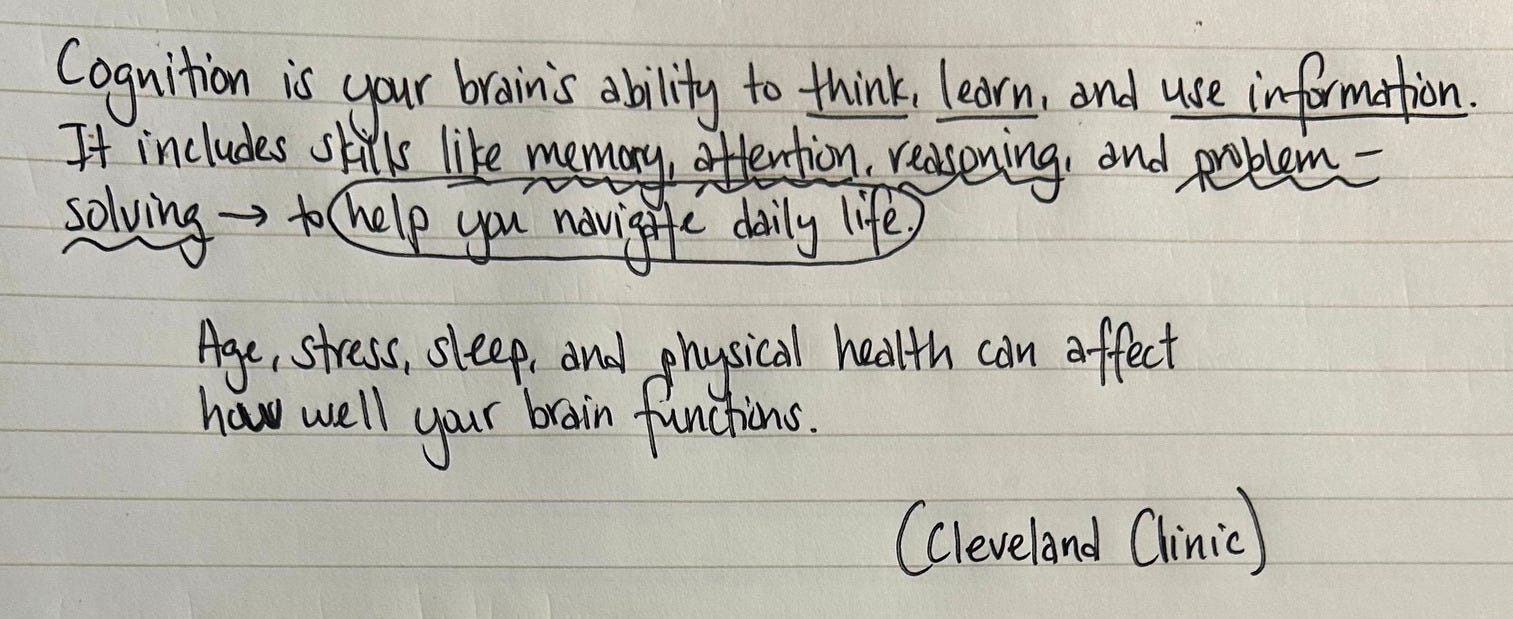
What is Cognition?
Cognition refers to the range of mental processes used to acquire, store, retrieve, and use information. Cognitive performance measures the efficiency and accuracy of processes such as attention, memory, and problem-solving when executing specific tasks.
How Might Cognition Affect PMOS?
Research indicates that hormonal disruptors associated with PCOS may affect not only the reproductive system but also the brain. Clinical symptoms such as hirsutism (excess hair growth) and acne are often linked to elevated androgen levels, which may also play a role in the development of the condition.
But do elevated levels of androgens in women with PCOS affect brain function as well?
2016 fMRI Study
A 2016 functional magnetic resonance imaging (fMRI) study published in Fertility and Sterility found that women with PCOS showed greater activation in parietal brain regions, your brain’s sensory and spatial processing center, during a working-memory task compared with healthy controls.
The study compared 14 women with PCOS and hyperandrogenism with 20 healthy control women who had no features of PCOS or other hormonal disorders. Participants completed a working-memory task while their brain activity was measured using fMRI, and the PCOS group was then assessed again after antiandrogenic treatment.
Note: There are more recent brain-imaging studies on PCOS available; however, the 2016 fMRI working-memory study remains the most relevant for cognition, that’s why I used it.
Before treatment, women with PCOS showed greater activity in the right superior and inferior parietal lobes during the working-memory task, even though their performance was similar to that of the controls. This suggests that they may need to recruit more neural resources to achieve the same level of performance, which points to reduced cognitive efficiency rather than obvious impairment. This means they may have to work harder mentally to do the same task, even if their results look normal.
After treatment, the differences in brain activity became smaller, and memory performance improved, suggesting that hormones may influence how the brain processes information. Androgens may shape cognitive processing.
2023 Review
A 2023 narrative review published in Obstetrics & Gynecology Science broadens this by showing that PCOS may be associated with more than one type of thinking or one part of the brain. The review found that women with PCOS may show weaker performance in areas such as face processing, memory, fine motor skills, and visuospatial ability, although the findings are not always consistent because the studies were small and used different methods.
Hormones, Insulin, and Mood
The review further points out that glucose and insulin may affect brain function, and that stress and emotional strain could also affect cognitive function. Since women with PCOS can experience one or both of these issues, physicians should pay attention not only to visible symptoms but also to attention, memory, and day-to-day functioning.
What We Still Don’t Know
These studies also highlight an important research gap. Much of the current evidence comes from small studies, so larger and better-controlled research is needed to sort out the effects of PCOS type, insulin resistance, psychological symptoms, and medication use. The current literature suggests that cognition should be considered part of the broader PCOS picture rather than a separate concern.
Why Does This Matter for PMOS Care?
As research continues to uncover the possible links between PCOS and cognition, it is clear that the condition may affect more than reproductive and metabolic health alone. Understanding these less visible effects could help improve care and lead to more complete treatment for women with PCOS.
I was listening to Endless Night, by Maeta while writing this!
July Learnings Post next week: 7/28. This month flew by! No push notification, but I will notify with a Substack Note.
Branding has been updated. I am still working on updating sections and the About section. It should be completed by next week.
References to Peer-Reviewed Papers on Cognition and PMOS
Soleman, R. S., Kreukels, B. P. C., Veltman, D. J., Cohen-Kettenis, P. T., Hompes, P. G. A., Drent, M. L., & Lambalk, C. B. (2016). Does polycystic ovary syndrome affect cognition? A functional magnetic resonance imaging study exploring working memory. Fertility and sterility, 105(5), 1314–1321.e1. https://doi.org/10.1016/j.fertnstert.2016.01.034
Naz, M. S. G., Rahnemaei, F. A., Tehrani, F. R., Sayehmiri, F., Ghasemi, V., Banaei, M., & Ozgoli, G. (2023). Possible cognition changes in women with polycystic ovary syndrome: a narrative review. Obstetrics & gynecology science, 66(5), 347–363. https://doi.org/10.5468/ogs.22165
Genuinely love being educated by ur articles 🙏 I actually learn so much from ur work
Really great piece!! I really like how you are bringing attention to these less visible cognitive effects. When someone is struggling with brain fog or mental burnout, it usually gets brushed off as "just stress" because the surface level stuff looks fine. I’m definitely sending this to a friend who’s trying to figure out if she has PMOS, having actual data to validate what she's feeling will mean a lot!! <3